
Academic year 2022/2023
20/06/2023
h 9:00
– ex SALA RIUNIONI (EX SOFTEL) Ed. 3
– Piano 1 a via Claudio
Online: Online participation via MS Teams link
In case your access is denied, log out from your institutional account and open MS Teams in your web browser.
Cosmo Lupo
(Politecnico di Bari)
Quantum communications with continuous variables of light
Abstract
Abstract: Quantum key distribution (QKD) and quantum random number generation (QRNG) are fundamental building blocks of quantum networks and the future quantum internet. QKD allows us to distribute secret keys between distant users through an insecure communication channel. QRNG yields high quality random bits, which are most valuable for cyber security. In this seminar I will discuss ways to realize these protocols using continuous variables of light, assessing pros and cons of this architecture compared with those based on discrete variables and photodetection.

05/05/2023
h14:30 – Aula 0M03
Dipartimento di Fisica
Online: Online participation via MS Teams link
ùIn case your access is denied, log out from your institutional account and open MS Teams in your web browser.
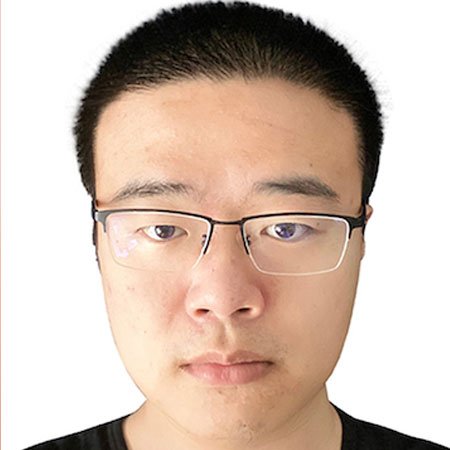
Andrea Trombettoni
(Università di Trieste, Italy)
Tilted 1D Bose Gases and Atomtronics Applications
Abstract
After a brief introduction on 1D ultracold gases, I discuss how to implement an integrable Floquet Hamiltonian for a periodically tilted 1D Bose gas. In general, an integrable model subjected to a periodic driving gives rise to a non-integrable Floquet Hamiltonian. Here we show that the Floquet Hamiltonian of the integrable Lieb-Liniger model in presence of a linear potential with a periodic time-dependent strength is instead integrable and its quasi-energies can be determined using the Bethe ansatz approach. We discuss various aspects of the dynamics of the system at stroboscopic times and we also propose a possible experimental realization of the periodically driven tilting in terms of a shaken rotated ring potential. We also discuss the micro-motion operator and the expression for a generic time evolved state of the system. To conclude, a discussion of the applications to atomtronics is presented.In recent years there has been an increasing interest in quantum computing from non-pundits, companies and researchers from fields other than quantum computing.
05/05/2023
h15:30 – Aula 0M03
Dipartimento di Fisica
Online: Online participation via MS Teams link
In case your access is denied, log out from your institutional account and open MS Teams in your web browser.
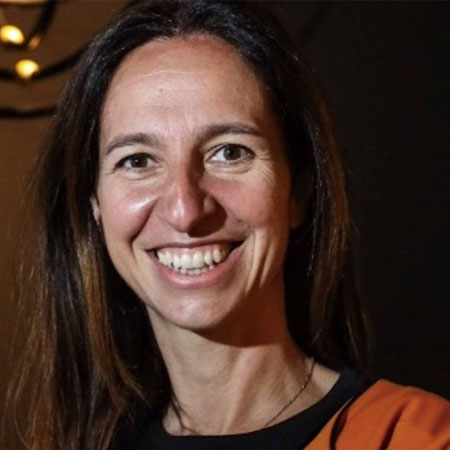
Gu Zhang
(Beijing Academy of Quantum Information Sciences, China)
Does delta-T noise probe quantum statistics?
Abstract
Abstract: We study delta-T noise—excess charge noise at zero voltage but finite temperature bias—for weak tunneling in one-dimensional interacting systems. We show that the sign of the delta-T noise is generically determined by the nature of the dominating tunneling process. More specifically, the sign is governed by the leading charge-tunneling operator’s scaling dimension. We clarify the relation between the sign of delta-T noise and the quantum exchange statistics of tunneling quasiparticles.We find that, for infinite systems hosting chiral channels with local interactions (e.g., quantumHall or quantum spin Hall edges), when the delta-T noise is negative, the tunneling particles are boson-like, revealing their tendency towards bunching. However, the opposite is not true: Boson-like particles do not necessarily produce negative delta-T noise. Importantly, the bosonic nature of particles generating the negative delta-T is not necessarily intrinsic, but can be induced by the interactions. This, in particular, implies that negative delta-T noise for tunneling between the edge states cannot serve as a smoking gun for detecting “intrinsic anyons”. We also establish a connection between the delta-T noise and the temperature derivative of the Nyquist-Johnson (thermal) noise in interacting systems, both governed by the same scaling dimensions. As a demonstration of the above statements, we study tunneling between two interacting quantum spin Hall edges. With bosonization and renormalization-group techniques, we find that many-body interactions can generate negative delta-T noise for both direct tunneling through a point contact and in Kondo exchange tunneling via a localized spin. In both these setups, we show that the noise can become negative at sufficiently low temperatures, when interactions renormalize the tunneling to favor boson-like pair-tunneling of electrons rather than single-electron tunneling. Our findings show that delta-T noise can be used to probe the nature of collective excitations in interacting one-dimensional systems.
13/04/2023
h15:00 – Aula Caianiello
Dipartimento di Fisica
Online: Online participation via MS Teams link
In case your access is denied, log out from your institutional account and open MS Teams in your web browser.
Costanza Toninelli
(CNR-INO, Italy)
Single Organic Molecules for Photonic Quantum Technologies
Abstract
I review recent scientific work performed at the University of Catania on the dynamics of superconducting architectures in the ultrastrong coupling (USC) regime.
First, I will address the problem of the detection of virtual photons from the ground-state of a USC system. This is a long-standing problem which still awaits experimental demonstration. We show that combining an unconventional design of the device, state-of-the-art superinductor technology, and advanced control techniques one may convert virtual photons to real ones, which can be detected, with nearly 100% efficiency, very large fidelity. Out protocol being resilient to a strong measurement backaction, it allows to integrate a relatively simple measurement procedure allowing to discriminate virtual from thermal photons.
Then, I will highlight new results on Quantum operations for modular computing with USC systems. Solid-state systems made of artificial atoms (AA) and cavity modes in the strong coupling (SC) regime are a well-established architecture for quantum computing leveraging the ability of manipulating individual excitations. The clock rate is fixed by the interaction strength suggesting that in the USC regime ultrafast quantum operations may be performed. However, faster dynamics has a cost since USC breaks conservation of the number of excitations leading to a series of new fundamental effects which are unfortunately detrimental to quantum state processing.
We study strategies for suppressing the impact of such errors in a system of AAs USC-coupled to a quantized harmonic mode. We introduce a class of adiabatic protocols using the mode as a virtual quantum bus and show that substantial speedup together with high fidelity may be demonstrated for selected key operations, such as state transfer between remote units, state swapping, bi- and multi-partite entanglement generation and sharing. We derived a suitable low-energy description of the problem and found analytically a control strategy which suppresses errors down to ~10-6 for state transfer. These results were improved by optimal control numerical techniques and their robustness against parametric fluctuations and noise was shown.

05/04/2023
h15:00 – Aula Caianiello
Dipartimento di Fisica
Online: Online participation via MS Teams link
In case your access is denied, log out from your institutional account and open MS Teams in your web browser.
Nicola Lo Gullo
(University of Calabria, Italy)
Enhancing quit readout with Bayesian Learning
Abstract
In recent years there has been an increasing interest in quantum computing from non-pundits, companies and researchers from fields other than quantum computing.
This is undoubtedly due to the deployment of quantum computing resources to research institutions and companies, which fostered the search for new applications of quantum computing.
Currently available quantum processing units (QPUs) are typically small and are plagued by noise. Two main solutions are being investigated to improve them: on the one hand there is an ongoing technological effort in scaling up these devices controlling the noise and, at the same time, develop error correction codes which will make the QPUs robust to errors; on the other hand there are efforts in making the current small and noisy devices useful. Quantum error mitigation is a class of techniques aiming at reducing the errors in running codes on quantum computers.
Within this framework we introduce an efficient and accurate readout measurement scheme for single and multi-qubit states. Our method uses Bayesian inference to build an assignment probability distribution for each qubit state based on a reference characterization of the detector response functions. This allows us to account for system imperfections and thermal noise within the assignment of the computational basis. We benchmark our protocol on a quantum device with five superconducting qubits, testing initial state preparation for single and two-qubit states and an application of the Bernstein-Vazirani algorithm executed on five qubits. Our method shows a substantial reduction of the readout error and promises advantages for near-term and future quantum devices.

28/02/2023
h15:00 – Aula Caianiello
Dipartimento di Fisica
Online: Online participation via MS Teams link
In case your access is denied, log out from your institutional account and open MS Teams in your web browser.
Halima Giovanna Ahmad
(University of Naples Federico II, Italy)
Novel tuning approaches for unconventional superconducting qubits
Abstract
In the last decades, the search for novel quantum platforms has increased due to the request for high-performing quantum computing. Superconducting quantum processors have the advantage to be strongly engineerable, in terms of both integrated materials, circuital designs and easy-interface with commercially available readout/control electronics. In spite of the enormous advancements in the field, the research community is still facing several challenges in terms of scalability and coherence.
Josephson devices integrating unconventional barriers, such as topological insulators, Van der Waals heterostructures and hybrid ferromagnetic/superconducting devices, offer the possibility to establish novel tunability schemes not only in superconducting qubits, but also in other Josephson-based quantum devices, ranging from cryogenic amplifiers to interconnecting bus and coupling devices. Moreover, hybrid superconducting quantum devices provide a novel platform for the study of quantum phenomena at the interface between different materials and noise fluctuations in solid-state devices.
We here report on the study of novel tunability schemes for flux-tunable superconducting transmon qubits, by integrating in the device unconventional low-dissipative tunnel ferromagnetic Josephson junctions (SFS JJs). In this novel hybrid ferromagnetic transmon qubit, namely the ferrotransmon, the qubit frequency can be tuned by means of in-plane magnetic field pulses, by exploiting the magnetic hysteretic behavior in the ferromagnetic barrier, rather than continuous magnetic flux fields, thus possibly reducing the impact of flux-noise decoherence. The enhanced tunability of SFS junctions can be of reference for a large variety of superconducting quantum devices.
24/01/2023
h11:30 – Aula 0M01
Dipartimento di Fisica
Online: Online participation via MS Teams link
In case your access is denied, log out from your institutional account and open MS Teams in your web browser.
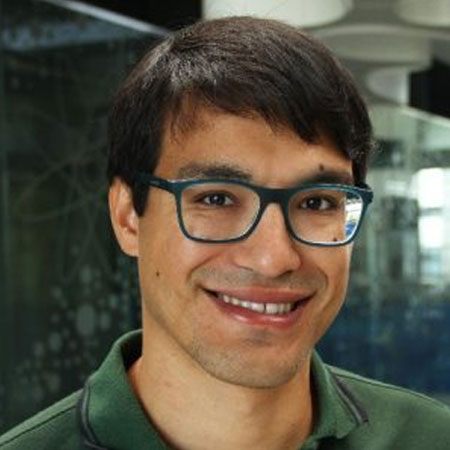
Bereneice Sephton
(University of Naples Federico II, Italy)
Towards teleporting quantum images
Abstract
Quantum teleportation allows the disembodied transferral of information between two destinations. A general teleportation approach exploits entanglement between two photons to convey information between two destinations without the information physically existing in the path between them. Indirect (Bell) measurements, between one of the entangled photons and a state one desires to transmit, then allows the disembodied information to be conveyed elsewhere, moderated by classical communication. Physically developing such a protocol is of interest across a variety of quantum information tasks as it forms a salient toolbox from quantum computing to security and quantum networks, sparking much research into the practical implementation thereof. This has been demonstrated with a variety of approaches ranging from NMR to solid state systems, but the highest dimension teleported is limited to three and requires an extra (ancillary) photon pair for every dimensional increase. A trade-off for higher dimensions has been setups that are difficult to scale and resource intensive if further dimensions are desired.
In an effort towards practically feasible teleportation of systems such as images, multi-level atoms or molecules, we consider side-stepping the scalability issue with and explore a non-linear approach in place of the traditional linear implementation for the entangling Bell step. With this, we experimentally show high-dimensional teleportation exceeding 10 dimensions for twisted light as well as other spatial states with fidelities beyond the classical limit. The results open the way towards implementing teleportation in a practically useful way with an encouraging paradigm allowing versatile and high-capacity optical quantum communication protocols for on-demand states.
25/11/2022
h11:30 – Aula Caianiello
Dipartimento di Fisica
Online: Online participation via MS Teams link
In case your access is denied, log out from your institutional account and open MS Teams in your web browser.
Alexandre Dauphin
(The Institute of Photonic Sciences – ICFO, Spain)
Self-trapped polarons and topological defects in a topological Mott insulator
Abstract
In the last decades, topological insulators have attracted great interest and also have promising applications in topics such as metrology or quantum computation. These exotic materials go beyond the standard classification of phases of matter: they are insulating in their bulk, conducting on their edges, and characterized by a global topological invariant, in contrast to a local order parameter as in the conventional Ginzburg-Landau theory of phases of matter.
Such topological phases have been experimentally observed in condensed matter systems and more recently in quantum simulators. The latter are very versatile platforms that allow one to simulate a material with another quantum system in a very controllable environment. In the case of topological insulators, this degree of control is particularly promising to unveil the mechanisms leading to these phases.
The quantum simulation of these exotic materials typically relies on the generation of artificial gauge fields. However, recent studies have shown that topological phases can also emerge from particle interactions. The latter mechanism leads to the concept of interaction-induced topological phases, in which topology is acquired through a spontaneous symmetry breaking process. The interplay of the spontaneous symmetry breaking with the global topological properties can lead to very interesting effects.
In this talk, I will discuss how such interplay can lead to new strongly-correlated topological effects in a 2D material. In particular, I will show how interactions can localize particles in the insulating bulk at incommensurate fillings, leading to self-trapped polarons. Furthermore at higher filling, the interacting nature of the topological insulator gives rise to domains in the bulk. Interestingly, the nontrivial topology associated to each domain leads to the appearance of protected conducting states in the bulk, localized at the domain boundaries. Finally, I will discuss the possibility of quantum simulating such phases with cold laser-excited Rydberg atoms in an optical lattice.
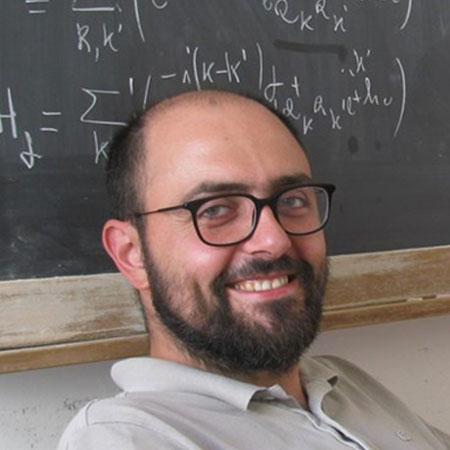
Marcello Dalmonte
(Abdus Salam ICTP Trieste, Italy)
Data mining the output of quantum simulators – from critical behavior to algorithmic complexity
Abstract
Recent experiments with quantum simulators and noisy intermediate-scale quantum devices have demonstrated unparalleled capabilities of probing many-body wave functions, via directly probing them at the single quantum level via projective measurements. However, very little is known about to interpret and analyse such huge datasets. In this talk, I will show how it is possible to provide such characterisation of many-body quantum hardware via a direct and assumption-free data mining. The core idea of this programme is the fact that the output of quantum simualtors and computers can be construed as a very high-dimensional manifold. Such manifold can be characterised via basic topological concepts, in particular, by their intrinsic dimension. Exploiting state of the art tools in non-parametric learning, I will discuss theoretical results for both classical and quantum many-body spin systems that illustrate how data structures undergo structural transitions whenever the underlying physical system does, and display universal (critical) behavior in both classical and quantum mechanical cases. I will conclude with remarks on the applicability of our theoretical framework to synthetic quantum systems (quantum simulators and quantum computers), and emphasize its potential to provide a direct, scalable measure of Kolmogorov complexity of output states.

02/11/2022
h15:00 – Aula Caianiello
Dipartimento di Fisica
Online: Online participation via MS Teams link
In case your access is denied, log out from your institutional account and open MS Teams in your web browser.
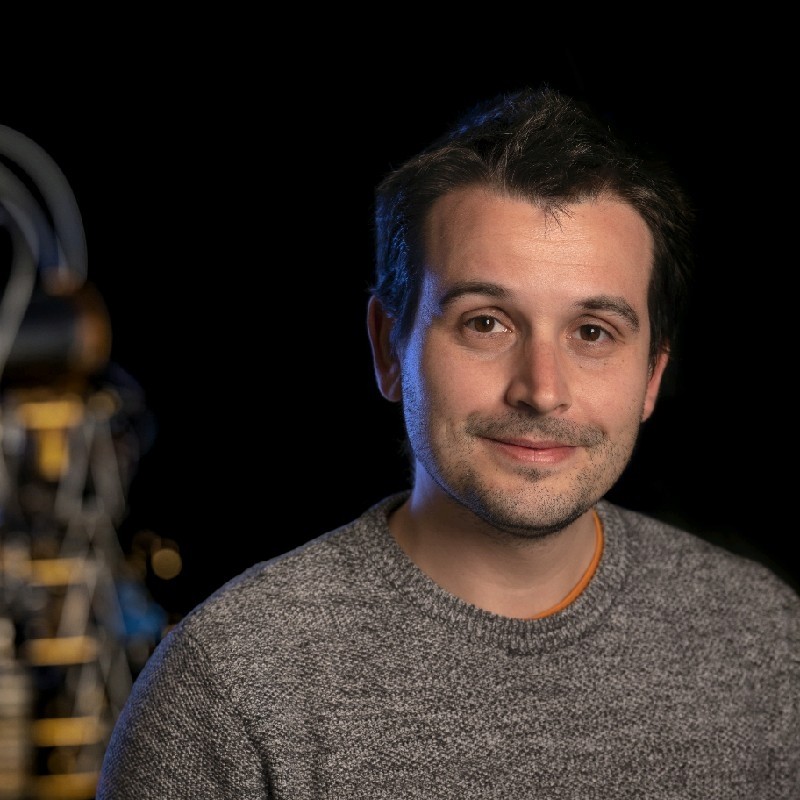
Alioscia Hamma
(University of Naples Federico II, Italy)
Stabilizer Renyi Entropy and Quantum Complexity
Abstract
Quantum physics is inherently different from classical physics and this difference comes in two layers. First, quantum correlations are stronger than classical correlations and do violate Bell’s inequalities. Second, based on the assumption that P is not NP, quantum physics is exponentially harder to simulate than classical physics.
The resource that makes quantum computers different from classical computers consists on those operations that go beyond the stabilizer formalism. In this talk, we show a new way of computing non-stabilizerness, called Stabilizer Renyi Entropy, and show how this quantity can be experimentally measured. We show how the Stabilizer Entropy determines the hardness of quantum verification, and how in turn it is involved in the onset of quantum complex behavior, as, e.g., revealed in the Out-of-Time-Order correlators. Moreover, we show how Stabilizer Renyi Entropy determines the complexity of a Black Hole.
Time permitting, we sketch a new approach to quantum complexity based on the interplay of entanglement and non-stabilizerness.
07/10/2022
h11:00 – Aula Caianiello
Dipartimento di Fisica
Online: Online participation via MS Teams link
In case your access is denied, log out from your institutional account and open MS Teams in your web browser.
Nicolò Crescini
Institut Néel-CNRS, Grenoble France
Dual Shapiro steps in a Josephson junctions array
Abstract
The modern primary voltage standard is based on the AC Josephson effect and the ensuing Shapiro steps, where a microwave tone applied to a Josephson junction yields a constant voltage hf/2e (h is Planck’s constant and e the electron charge) determined by only the microwave frequency f and fundamental constants. Duality arguments for current and voltage have long suggested the possibility of dual Shapiro steps–that a Josephson junction device could produce current steps with heights determined only on the applied frequency. In our setup we embed an ultrasmall Josephson junction in a high impedance array of larger junctions to reveal dual Shapiro steps. For multiple frequencies, we detect that the AC response of the circuit is synchronised with the microwave tone at frequency f, and the corresponding emergence of flat steps in the DC response with current 2ef, equal to the transport of a Cooper pair per tone period. This work sheds new light on phase-charge duality, omnipresent in condensed matter physics, and extends it to Josephson circuits. Looking forward, it opens a broad range of possibilities for new experiments in the field of circuit quantum electrodynamics and is an important step towards the long sought closure of the quantum metrology electrical triangle.