
Quantum Information Theory 1
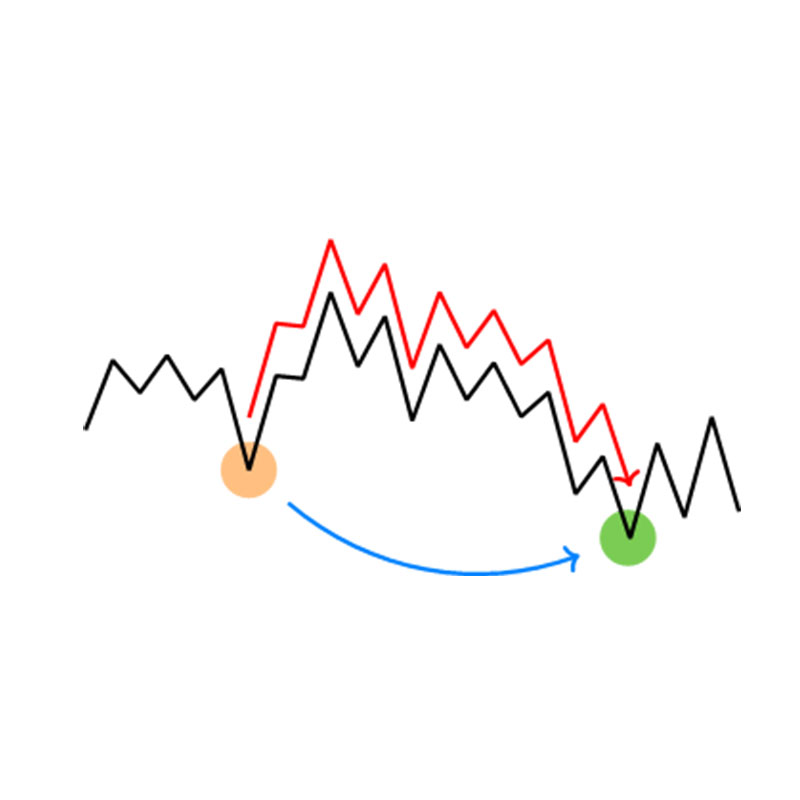
– Adiabatic quantum computation
Adiabatic quantum computation aims to solve optimization problems more efficiently than classical algorithms, but has to deal with noise and imperfections. We numerically study unitary and dissipative dynamics of quantum spin systems to model AQC and look for smart ways to further optimize this algorithm, using innovative protocols, optimal control, and shortcuts to adiabaticity.
References:
P. Hegde at al., Deep learning optimal quantum annealing schedules for random Ising models, New J. Phys. 25 073013 (2023)
P. Hegde et al., Genetic optimization of quantum annealing, Phys. Rev. A 105, 012612 (2022)
G. Passarelli et al., Counterdiabatic driving in the quantum annealing of the p-spin model: A variational approach, Phys. Rev. Research 2, 013283 (2020)
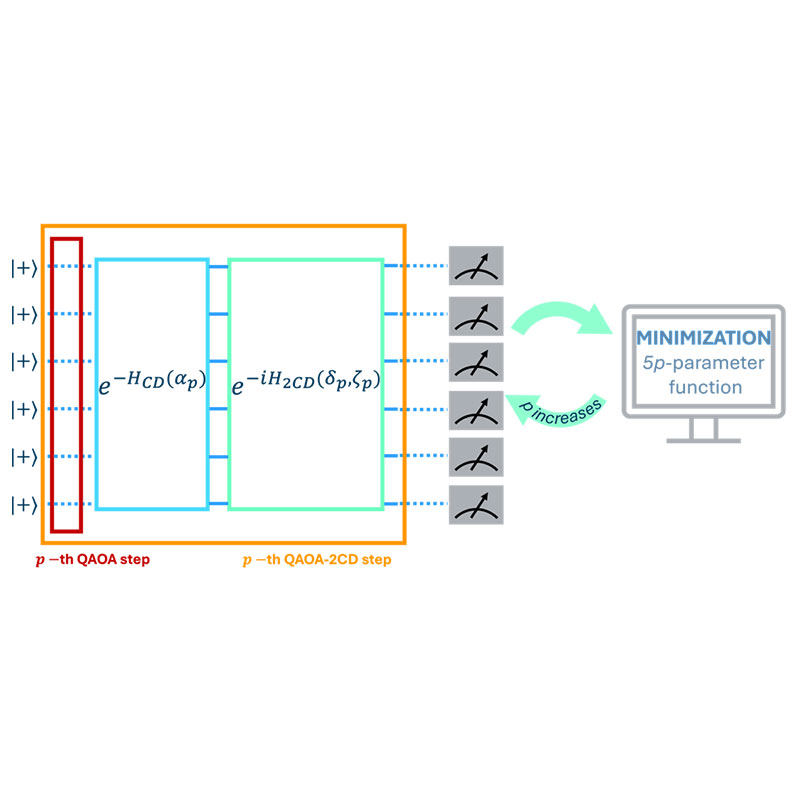
– Variational quantum circuits
Light is an invaluable tool for fast, non-invasive and accurate measurement of physical quantities. By exploiting NOON-like photonic states based on structured light we develop optical transducers of angular or mechanical displacements with enhanced sensing performances.
References:
M. Vizzuso et al., Convergence of digitized-counterdiabatic QAOA: circuit depth versus free parameters, New J. Phy 26 013002 (2024)
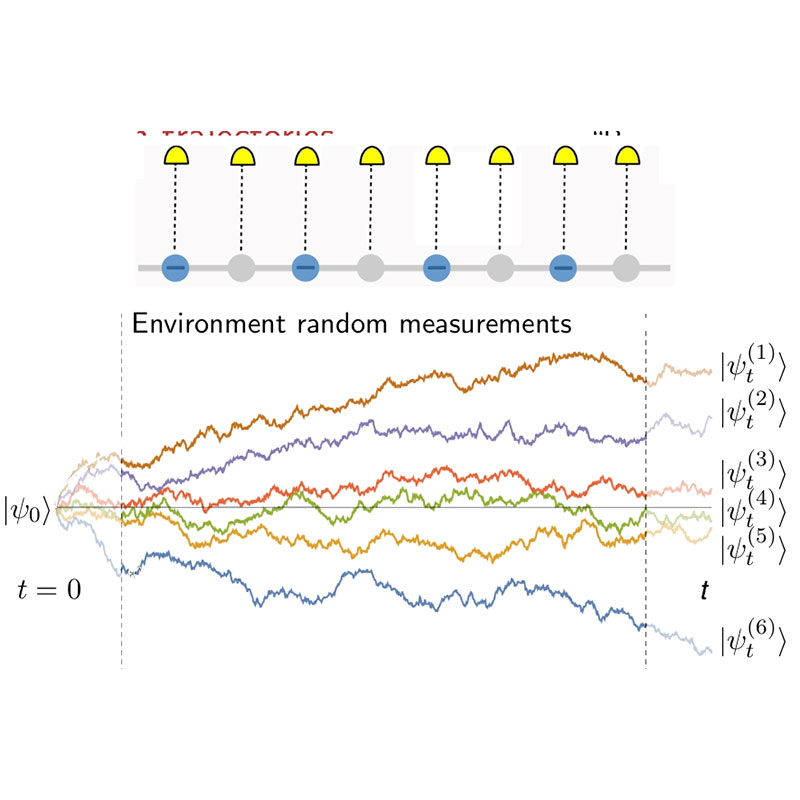
– Monitored quantum systems
Quantum systems propagating through a quantum circuit interrupted by random measurements can display a phase transition in their entanglement properties that is invisible at the level of the average (mixed) state and can only be resolved using quantum trajectories. Our group actively studies these measurement-induced phase transitions in different models in the context of dissipative quantum evolutions, where the random measurements are given by the interaction with an external environment.
References:
G. Passarelli et al., Many-Body Dynamics in Monitored Atomic Gases without Postselection Barrier, Phys. Rev. Lett. 132, 163401 (2024)
A. Russomanno et al., Entanglement transitions and quantum bifurcations under continuous long-range monitoring, Phys. Rev. B 108, 104313 (2023)
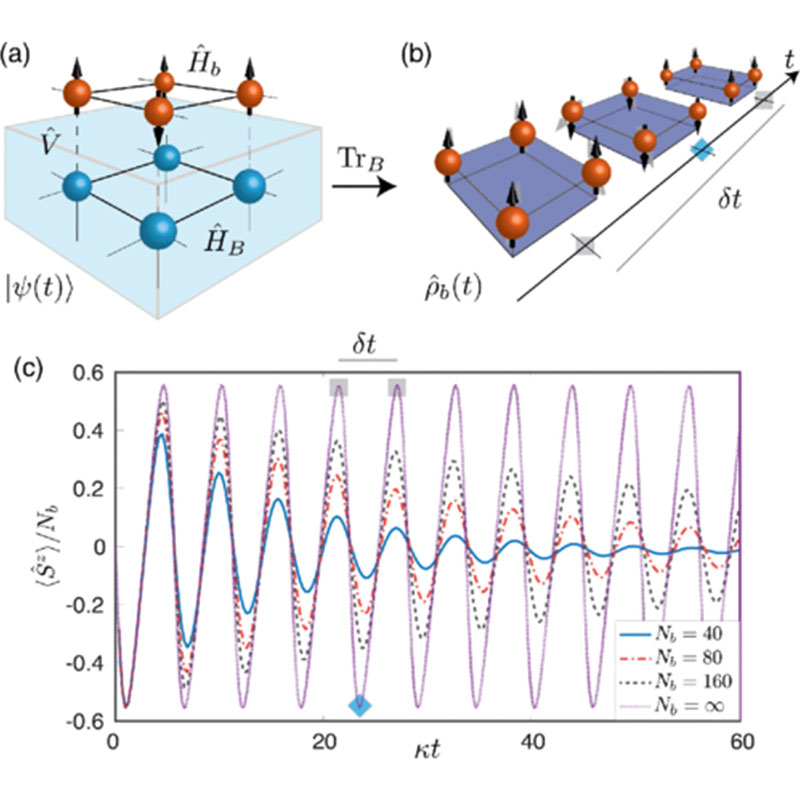
– Time crystals
Spontaneous symmetry breaking in the thermodynamic limit gives rise to phase transitions like the one leading the formation of crystals, where space translation symmetry is broken. Recently it has been found that also time-translation symmetry can be broken: a quantum many-body interacting system in the thermodynamic limit can spontaneously generate a collective periodic response — a time crystal. We study many different realizations of this exotic phase in unitary and dissipative systems.
References:
R. Gargiulo et al., Swapping Floquet time crystal, arXiv:2312.17070 (2023)
G. Passarelli et al., Dissipative time crystals with long-range Lindbladians, Phys. Rev. B 106, 224308 (2022)
F. Iemini et al., Boundary Time Crystals, Phys. Rev. Lett. 121, 035301 (2018)

– Parent Hamiltonian learning
Finding a Hamiltonian with local interactions that has a given many-body wave function as its ground state is a challenge of fundamental importance in quantum technologies. We tackle this problem from different angles, gaining information about the unknown Hamiltonian via delocalized evolutions and inverse quantum annealing, where we exploit the adiabatic theorem in reverse to desing an evolution in the space of local Hamiltonians.
References:
D. Rattacaso et al., Parent Hamiltonian Reconstruction via Inverse Quantum Annealing, Phys. Rev. Lett. 132, 160401 (2024)
D. Rattacaso et al., High-accuracy Hamiltonian learning via delocalized quantum state evolutions, Quantum 7, 905 (2023)
– Topological open systems
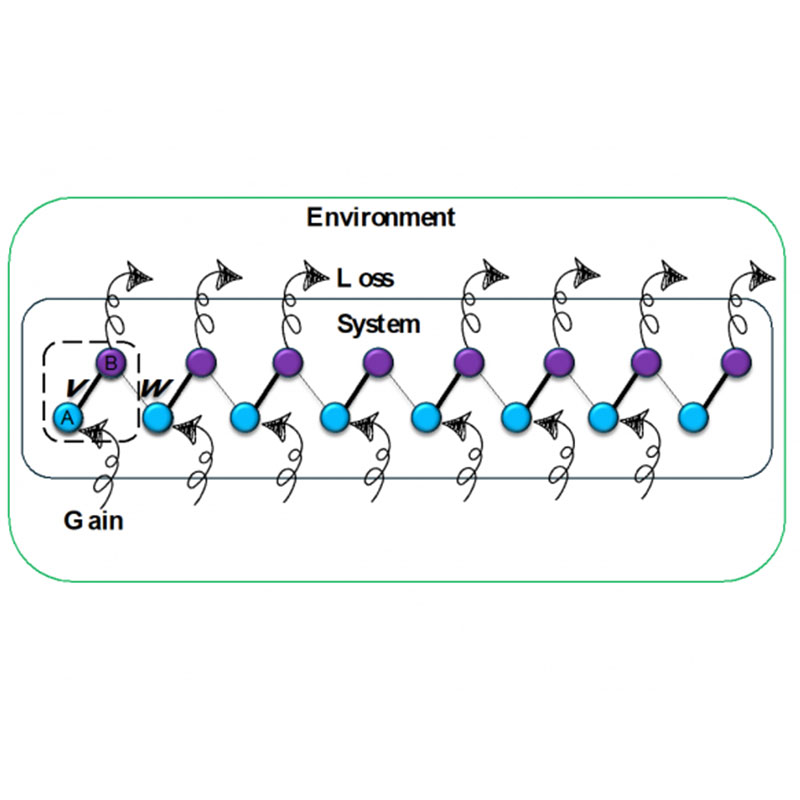
Traditional topological insulators are characterized by the presence of a non-trivial band topology which leads to an insulating bulk and symmetry-protected conducting surface states. How does dissipation change this picture? We investigate various aspects of open topological insulators, including their stability, transport and entanglement properties. Understanding how dissipation affects the topological protection of surface states is crucial for realizing practical applications in electronic devices and quantum technologies.

– Electronic semiclassical transport
The electronics of novel materials features often unusual behaviors and the quantum theory is required to gain insight. Unfortunately, due to impurities, vibrations and mutual interactions, the equations are often too complex to be analyzed or simulated and some clever simplification has to be performed. Semiclassical Boltzmann transport is an excellent hybrid approach where electrons are treated as (classical) particles with well-defined positions and speeds while still been constrained to live in (quantic) energy bands.
References:
Marco Marciani et al., “Resistivity anisotropy from the multiorbital Boltzmann equation in nematic FeSe”, Phys. Rev. B 106, 045102
– Many-body localization and ergodicity breaking
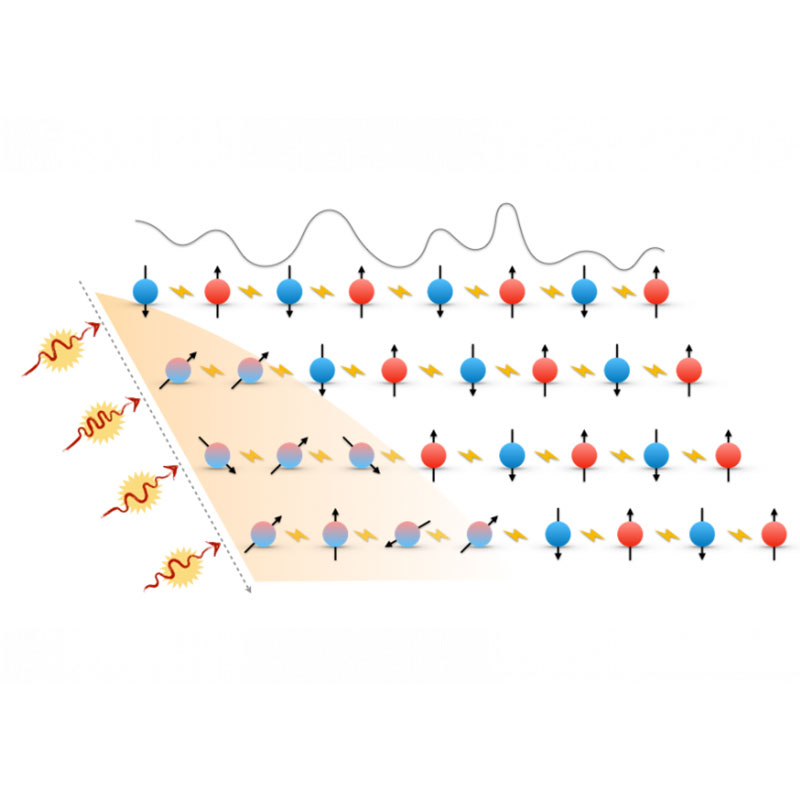
We numerical investigate the dynamics of disordered interacting quantum spin systems which fail to thermalize, breaking ergodicity, through exact diagonalization algorithms and tensor network tools such as time-dependent variational principle, studying local observables and the spreading of correlations.
– Theory of superconducting heterostructures for novel quantum devices
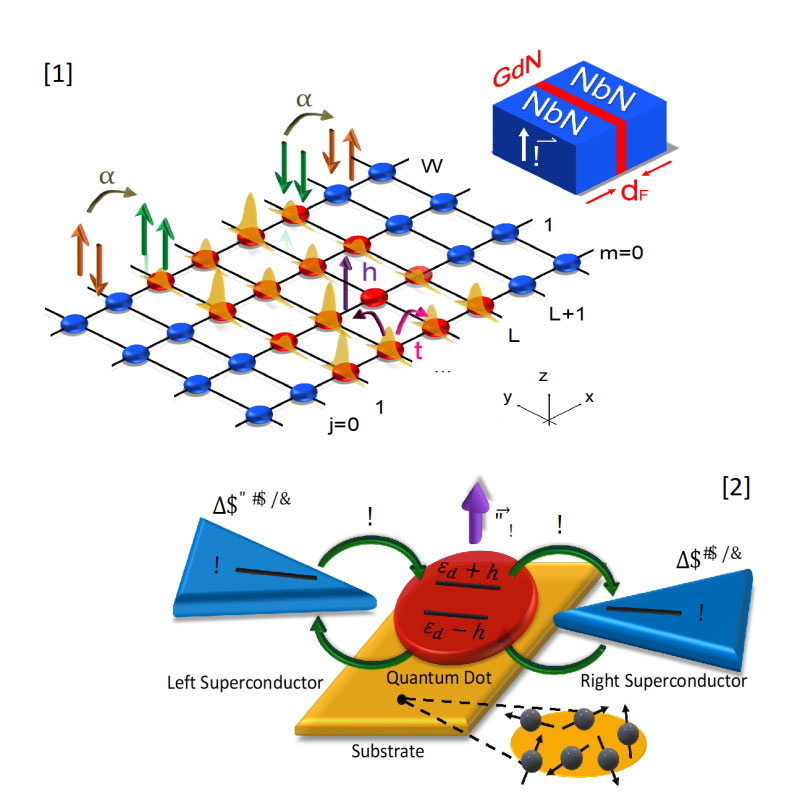
Lattice Green’s functions techniques, tight-binding Bogoliubov de Gennes models and Scattering Matrix methods represent sophisticate approaches to the study of quantum transport in mesoscopic devices. We investigate both transport and noise properties in Josephson junctions and novel superconducting heterostructures involving magnetic barriers, disorder and spin-mixing mechanisms.
References:
[1] H. G. Ahmad et al. “Coexistence and tuning of spin-singlet and triplet transport in spin-filter Josephson junctions”, Communications Physics 5, 2 (2022)
[2] R. Capecelatro et al. “Andreev spin-noise detector”, Physical Review B 108, 104508 (2023)