
Quantum Engineering

– Quantum nanophotonics
Our research investigates the interaction between quantum emitters and complex electromagnetic environments, particularly those that are open, dispersive, and absorbing. This area has attracted significant attention due to its potential for modifying emitter properties. Macroscopic quantum electrodynamics provides a powerful framework for quantizing the electromagnetic field within arbitrary open structures, including materials with dispersive and lossy characteristics. This approach is widely applied across various fields, from studying quantum emitter decay and cavity QED to quantum nanophotonics, dispersion forces, and fast electron scattering. Our work emphasizes advancing the Macroscopic QED model and developing robust computational methods to further these applications.
References:
G. Miano, L. M. Cangemi, C. Forestiere, “Quantum emitter interacting with a dispersive dielectric object: a model based on the modified Langevin noise formalism,” arXiv preprint arXiv:2410.10730 (2024)
C. Forestiere, G. Miano, “Operative approach to quantum electrodynamics in dispersive dielectric objects based on a polarization-mode expansion”, Physical Review A 106 (3), 033701 (2022)
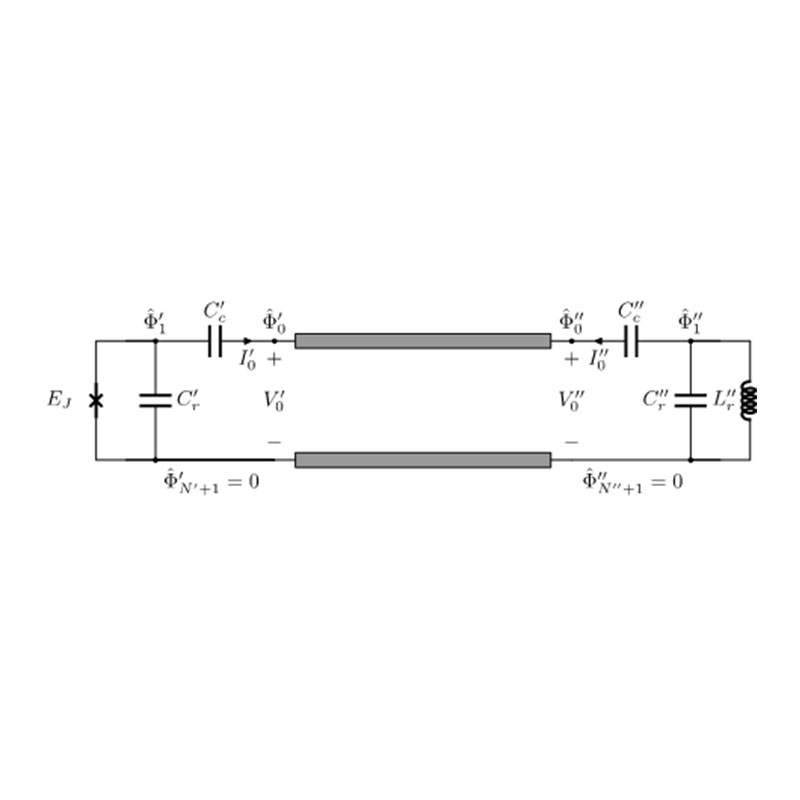
– Circuit quantum electrodynamics (QCE)
Over the past 30 years, the drive to create superconducting quantum processors has led to the development of circuit quantum electrodynamics (circuit-QED), a theory that models quantum electrical circuits. These circuits are superconducting, with the Josephson junction playing a crucial role. Our research explores the quantum electrodynamics of systems comprising transmission lines connected to lumped circuits, which include both linear elements—such as capacitors and inductors—and nonlinear elements like Josephson junctions. We focus on advancing the quantum circuit electrodynamics model, developing equivalent circuits, and creating sophisticated computational methods.
References:
C. Forestiere, G. Miano, “A δ-free approach to quantization of transmission lines connected to lumped circuits,” Physica Scripta 99 (4), 045123 (2024)
C. Forestiere, G. Miano, “Two-port quantum model of finite-length transmission lines coupled to lumped circuits,” Physical Review A 109 (4), 043706 (2024)
– Computational Electrodynamics
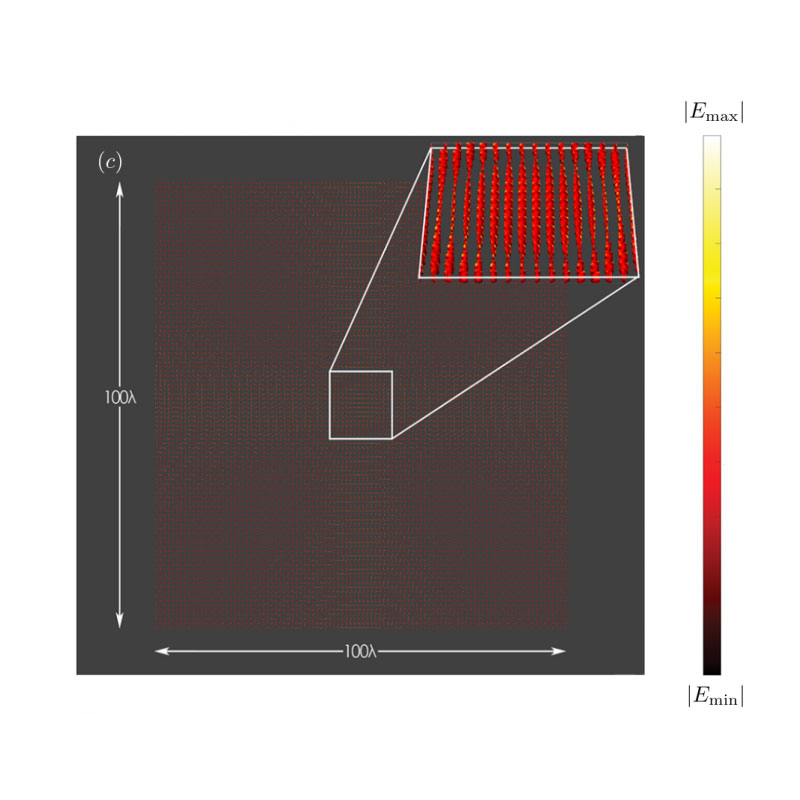
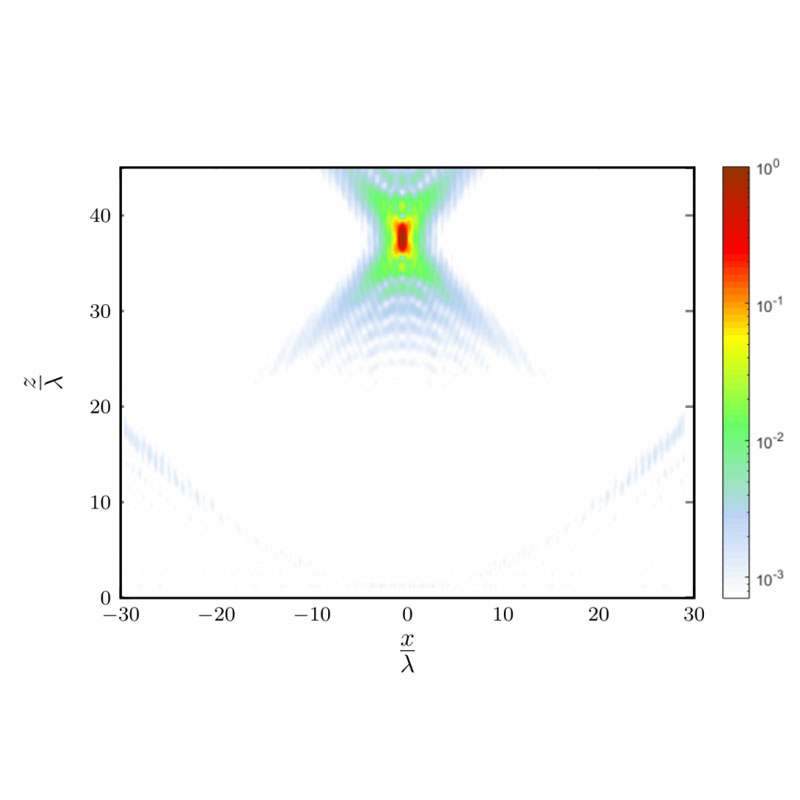
Efficient and accurate numerical solutions for electrodynamics problems are essential for both understanding the fundamental properties of complex nanophotonic devices and optimizing their performance. Our research focuses on developing innovative, high-speed numerical solvers tailored to complex nanophotonic systems, including both linear and nonlinear resonators as well as large metasurfaces.
References:
Forestiere, G. Miano, A. Alù, “First-principles nanocircuit model of open electromagnetic resonators,” Physical Review Applied 22 (3), 034014 (2024)
Corsaro, G. Miano, A. Tamburrino, S. Ventre, C. Forestiere, “Multilevel Fast Multipole Algorithm for Electromagnetic Scattering by Large Metasurfaces using a Static Mode Representation,” arXiv preprint arXiv:2407.21724 (2024)