
Quantum Optics 1
– Quantum walks and quantum simulations
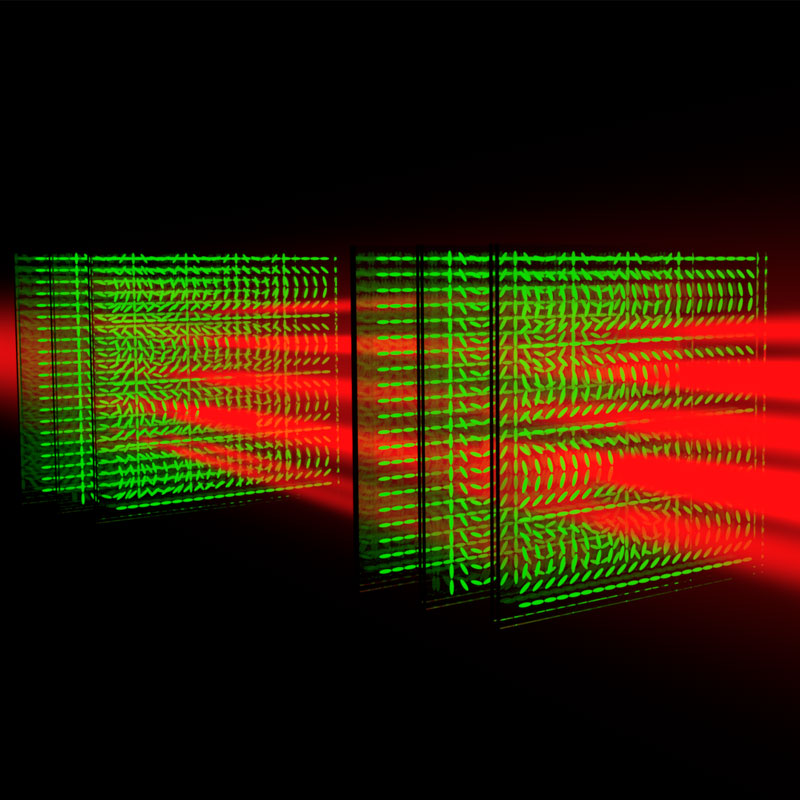
Photonic simulations of quantum dynamics permit the investigation of quantum phenomena in a controlled and accessible setup. We generate photonic quantum walks by dynamically altering photons wavefront and polarization, relying on metasurfaces whose action is based on optical spin-orbit interactions.
– Large-scale photonic circuits
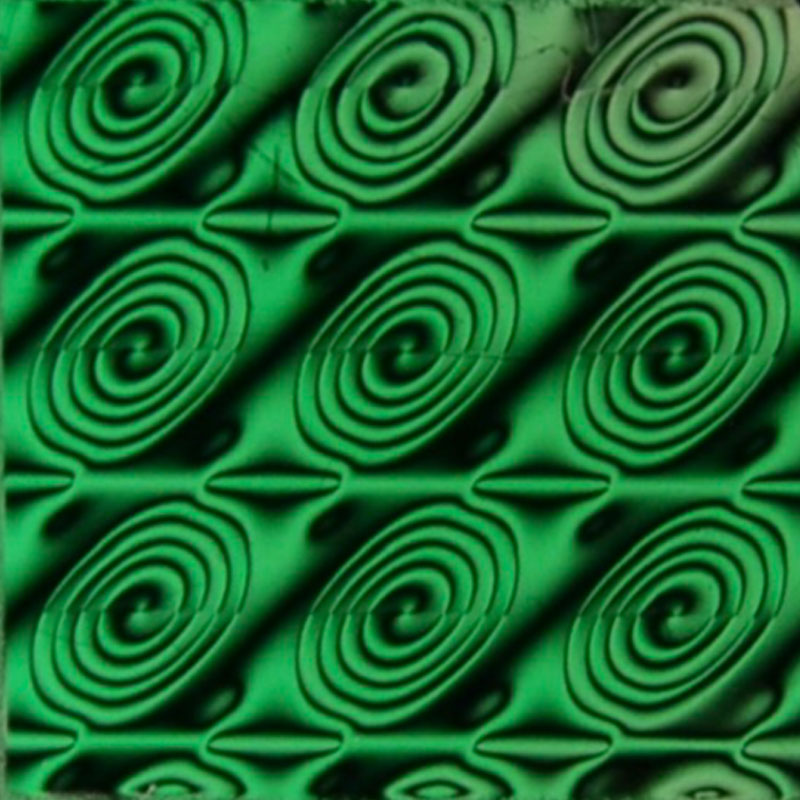
Photonic circuits serve as effective optical processors for both classical and quantum states of light. By leveraging liquid-crystal technology and spin-orbit photonics, we develop photonic circuits implementing large-scale unitary maps, linking a single input to hundreds of output modes in one- and two-dimensional layouts.
References:
Di Colandrea, F. et al. Ultra-long quantum walks via spin–orbit photonics. Optica 10, 324 (2023).
– Topological photonics
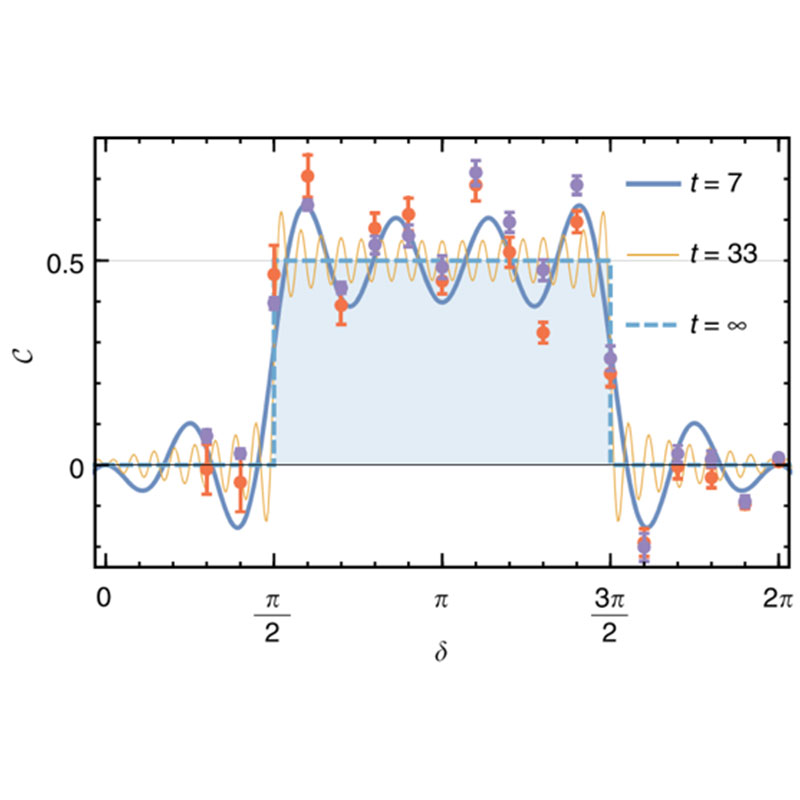
Topological photonics investigates how light behaves in custom-designed structures with unique topological properties. These properties are robust against certain perturbations and can lead to novel optical phenomena. Quantum walks of structured photons can be engineered to implement several topological systems, enabling the direct observation of novel and universal effects associated with the system’s topology.
References:
Cardano, F. et al. Detection of Zak phases and topological invariants in a chiral quantum walk of twisted photons. Nat. Commun. 8, 15516 (2017).
D’Errico, A. et al. Bulk detection of time-dependent topological transitions in quenched chiral models. Phys. Rev. Res. 2, 023119 (2020).
– Smart photonics via Artificial Intelligence
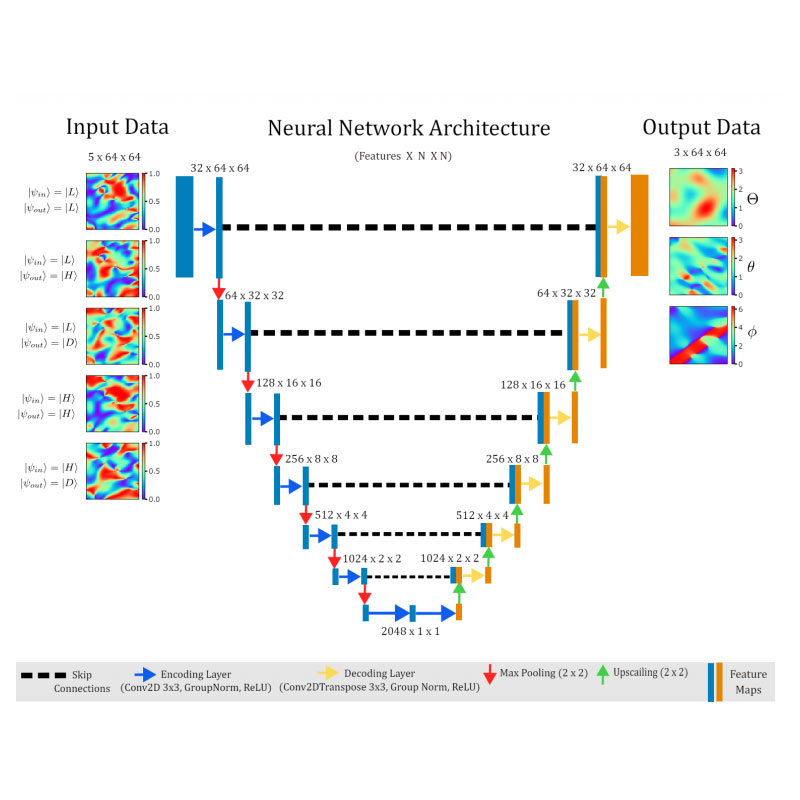
The application of advanced computational tools, such as deep learning and optimization algorithms, can boost the characterization and design of complex photonic experiments. We exploit these techniques to extract relevant information by performing only a few to minimal measurements on the setup, working at the intersection between photonics and machine learning, where the predictions of AI tools can suggest the roadmap for new physics in optical simulators and beyond.
References:
Di Colandrea, F. et al. Retrieving space-dependent polarization transformations via near-optimal quantum process tomography. Opt. Express 31, 20 (2023)
Jaouni T., et al. Quantum process tomography of structured optical gates with convolutional neural networks arXiv:2402.16616
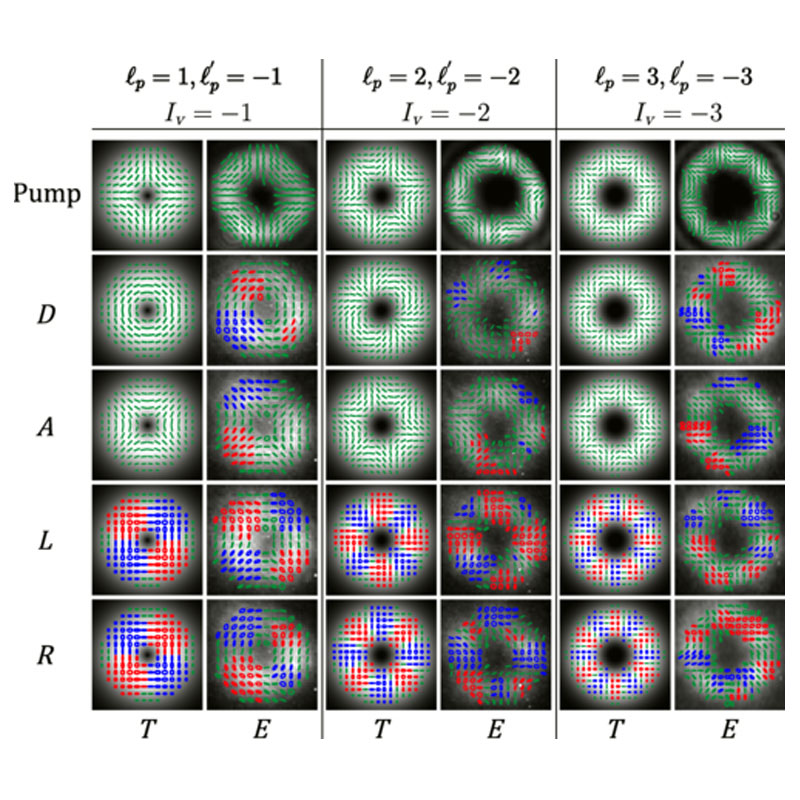
– Structured Dielectric Media for Quantum Photonics Devices
This activity is focused on advancing quantum information science and technologies through the development of novel quantum light sources and detection systems. Linear and Nonlinear Structured Dielectric Material (SDM), mainly based on liquid crystals technology, are engineered to develop very peculiar tasks while taking care to strictly minimize the number of required optical components. Our approach will contribute to address the scaling challenge in quantum computing. The researchers in this area also test fundamental questions in quantum photonics.
References:
Corona-Aquino, S., Ibarra-Borja, Z., Calderón-Losada, O., Piccirillo, B., Vicuña-Hernández, V., Moctezuma-Quistian, T., Cruz-Ramírez. H, Lopez-Mago, D., U’Ren, A. B. Generation of heralded vector-polarized single photons in remotely controlled topological classes Phys. Rev. Applied 21, 034030 (2024).
https://doi.org/10.1103/PhysRevApplied.21.034030
Cimini, V., Polino, E., Belliardo, F., Hoch, F., Piccirillo, B., Spagnolo, N, Giovannetti, V., Sciarrino, F. Experimental metrology beyond the standard quantum limit for a wide resources range NPJ Quantum Inf 9, 20 (2023).
https://doi.org/10.1038/s41534-023-00691-y